
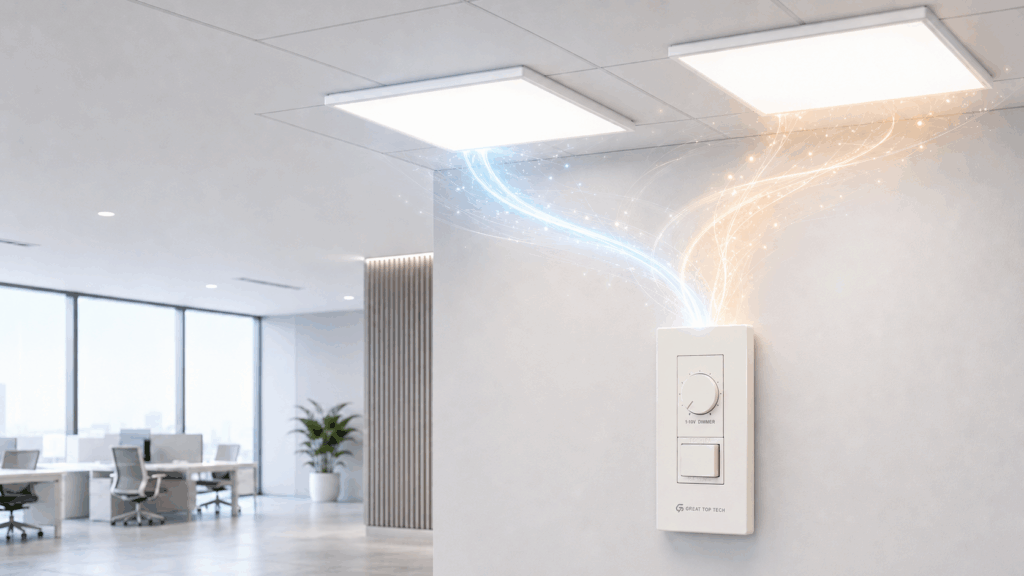
Author / Technical Review: Greattop Lighting Technology Team
Last Updated: July 31, 2026
0–10V and 1–10V are common analog dimming methods used in commercial lighting. They are widely applied in offices, classrooms, meeting rooms, retail spaces, and group control of multiple LED luminaires.
Although their names differ by only one number, they can differ in minimum dimming level, switching-off method, controller design, LED driver specifications, and wiring requirements. Simply pairing products based on their labels may result in excessively high minimum brightness, luminaires that cannot fully switch off, uneven dimming, or unsynchronized operation across multiple fixtures.
The key selection principle is: do not rely solely on the “0–10V” or “1–10V” label. Confirm the LED driver and controller’s control range, control current, minimum output level, and switching-off method together.
What Is 0–10V Dimming?
0–10V dimming uses a low-voltage control signal to send brightness commands to an LED driver. In general, the closer the control voltage is to 10V, the higher the luminaire output. As the control voltage decreases, the light output also decreases.
However, whether “0V” means complete switch-off cannot be determined by the name alone. Some LED drivers support electronic switch-off, while others maintain a minimum output at low voltage and therefore still require a switch or relay to disconnect the mains power.
When selecting a 0–10V dimming system, confirm:
- Whether the LED driver supports 0–10V control.
- Whether the luminaire reaches minimum brightness or switches off completely at the lowest control voltage.
- Whether an additional switch or relay is needed to control the mains power.
- Whether the controller and driver control currents are compatible.
- The number of drivers that can be connected to the same control circuit.
- Whether the dimming curve suits the intended use of the space.
What Is 1–10V Dimming?
1–10V dimming also uses a low-voltage analog signal to control an LED driver. Under normal operation, the luminaire delivers higher output as the control voltage approaches 10V. As the voltage falls toward 1V, the luminaire reaches the minimum brightness specified for that product.
1–10V dimming is commonly used in offices, meeting rooms, classrooms, retail displays, and grouped LED panel-light control. Because different drivers may use different minimum-brightness and switch-off logic, the luminaire and driver specifications should always govern the actual system design.
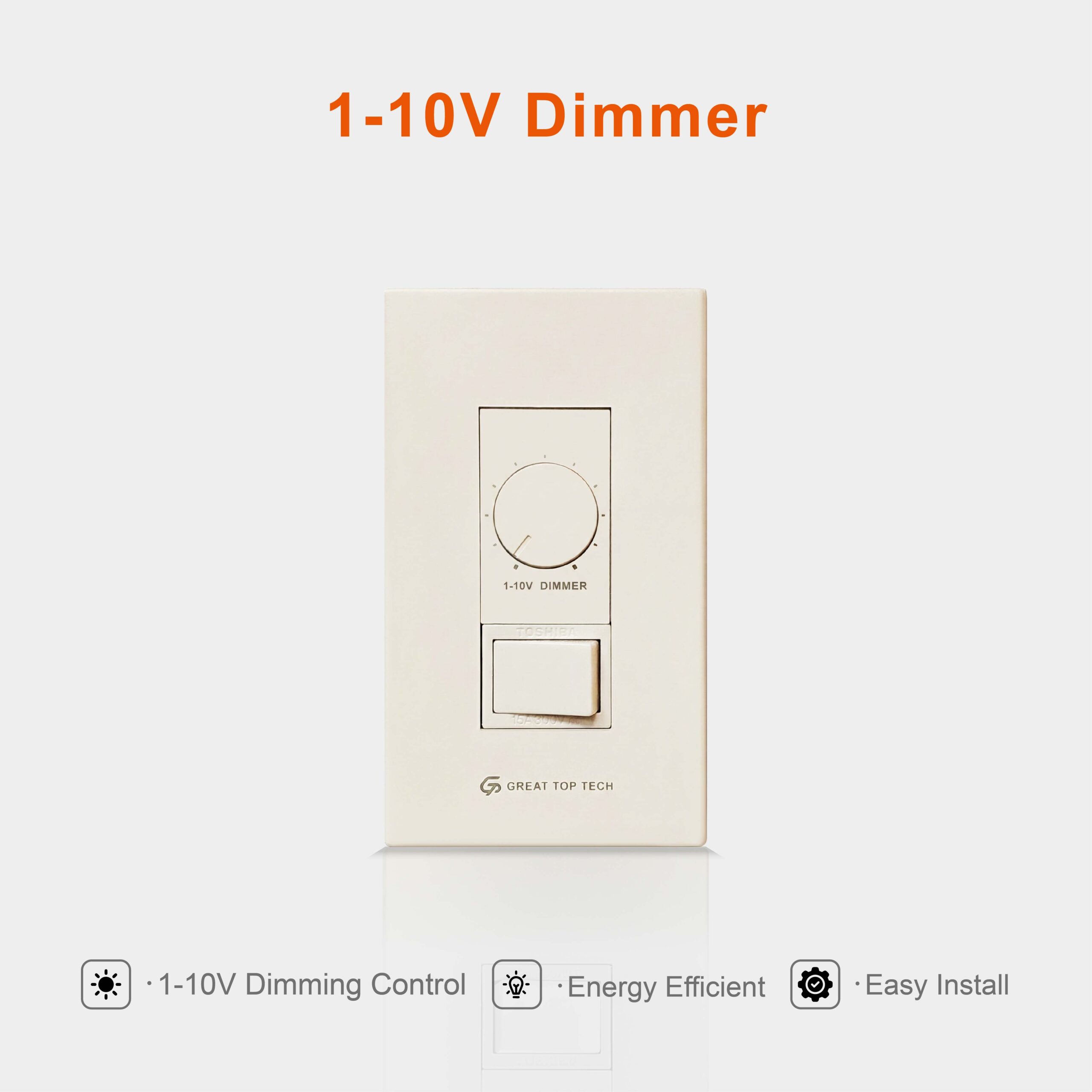
Greattop’s1–10V dimmerprovides a 1–10V control output, supports a maximum control-output load of 20 mA, and includes a 10 A switching contact. The actual number of drivers that can be controlled should be confirmed based on each driver’s control current and the site wiring conditions.
0–10V vs. 1–10V Dimming: Key Differences
| Comparison Item | 0–10V Dimming | 1–10V Dimming |
|---|---|---|
| Control Method | Low-voltage analog control signal | Low-voltage analog control signal |
| Typical Control Range | Approximately 0V to 10V | Approximately 1V to 10V |
| Minimum Brightness | Depends on the LED driver design | Usually determined by the driver’s minimum output setting |
| Complete Switch-Off | Verify whether the controller and driver support electronic switch-off. | Verify driver and controller specifications. Some systems require a switch contact or dimmer for switching off. |
| Common Applications | Commercial lighting, offices, system integration | Offices, classrooms, flat-panel lighting, and grouped lighting control |
| Greattop Compatible Solutions | 0–10V dimmable LED luminaires | 1–10V dimmer、1–10V dimmers and 1–10V dimmable LED panel-light combinations |
Although 0–10V and 1–10V dimming are conceptually similar, they should not be assumed to be interchangeable simply because their terminal connections or names look alike. Actual dimming performance can still be affected by the driver’s control circuit, minimum dimming level, control current, and system wiring.
Can 0–10V and 1–10V Be Used Interchangeably?
It is not recommended to assume they are directly interchangeable.
Some 0–10V controllers may adjust the brightness of 1–10V drivers, but the minimum dimming level, switching-off behavior, and dimming curve may not perform as expected. Common issues include:
- The luminaire remains slightly illuminated at the lowest setting.
- Brightness changes noticeably at the beginning of the control knob’s range, but becomes difficult to perceive toward the end.
- Multiple luminaires have inconsistent minimum brightness levels.
- The driver remains powered even after the controller is switched off.
- The controller’s current capacity is insufficient to support multiple drivers.
Therefore, during engineering selection, the specifications of both the controller and LED driver should be verified. For retrofit projects, inspect the existing wiring and control method first, then determine whether the luminaires, drivers, or dimmers need to be replaced.
How Are 0–10V and 1–10V Dimming Systems Wired?
These dimming systems typically include two separate circuits:
- Main power wiring:Supplies the electrical power required for the LED driver and luminaire to operate.
- Low-voltage control wiring:Transmits the dimming command and determines the LED driver’s light-output level.
The control wiring and main power wiring serve different functions and must not be interconnected. When multiple luminaires share one controller, also confirm the controller’s output load capacity, the control current required by each driver, and any voltage drop caused by the length of the control wiring.
For projects involving mains voltage, control circuits, or commercial lighting installations, follow the manufacturer’s wiring diagram and local electrical regulations. Installation and testing should be carried out by qualified electrical personnel.
How Should You Choose for Offices and Commercial Spaces?
When Multiple Panel Lights Need Synchronized Dimming
For offices, classrooms, and meeting rooms where multiple luminaires need to adjust brightness together, 0–10V or 1–10V control can be evaluated first. Confirm that the luminaire drivers support the same control signal, as well as the number of luminaires that can be connected to a single control circuit.
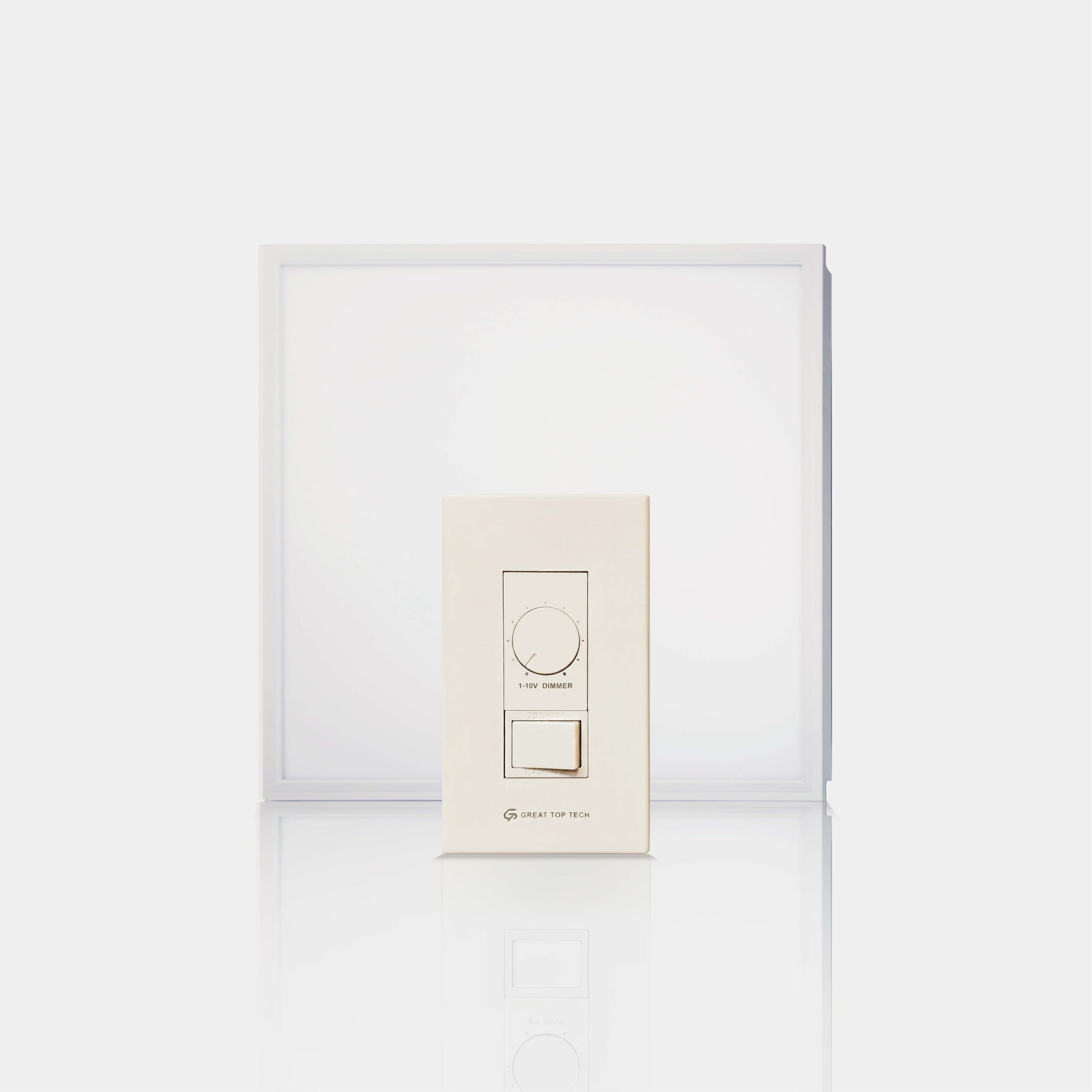
For an integrated luminaire and dimming-control solution, refer toGreattop LED Panel Light + 1–10V DimmerIts product information indicates suitability for lighting applications including corporate offices, commercial displays, healthcare facilities, and educational institutions.
When Adding Control Wiring Is Difficult
If it is impractical to add low-voltage control wiring on site, TRIAC luminaires and trailing-edge dimmers that support phase-cut dimming can be considered. However, the luminaire or LED driver must clearly state compatibility with that dimming method to avoid unstable low-level dimming, audible noise, or failure to adjust brightness.
Further reading:Leading-Edge vs. Trailing-Edge TRIAC Dimming
When More Precise LED Brightness Control Is Required
If the system needs to control LED output using pulse signals, PWM dimming can be considered. PWM, 0–10V, and 1–10V are different control methods; they cannot be converted simply by replacing the wall dimmer. The LED driver and overall system architecture must still be verified.
You can further compare theGreattop LED Dimmer Seriesand select a 1–10V, PWM, or trailing-edge TRIAC dimming solution based on the luminaires, drivers, control wiring, and application requirements.
Check These Details Before Selecting an LED Dimmer
- Luminaire model and LED driver model.
- Dimming method supported by the driver.
- Control-voltage range and control current.
- Minimum dimming level and whether complete switch-off is required.
- Number of luminaires and drivers on a single control circuit.
- Mains supply voltage and anticipated total load.
- Control-wire length and site wiring conditions.
- Whether occupancy sensing, scheduling, group control, or wireless control is required.
The more complete the information, the easier it is to confirm before installation whether the controller, LED driver, and luminaires are compatible—reducing later adjustment and maintenance costs.
Frequently Asked Questions
Does 0–10V Dimming Always Allow Complete Switch-Off?
Not necessarily. Complete switch-off depends on whether both the controller and LED driver support electronic switch-off. If the system does not support it, the mains power will usually need to be disconnected using a switch or relay.
Can a 1–10V Dimmer Control a 0–10V Driver?
Some combinations may adjust brightness, but their minimum brightness, switch-off method, and dimming curve may differ. Confirm both specifications before use, and perform a compatibility test where necessary.
Why Do Multiple LED Lights Have Inconsistent Brightness?
This may be caused by different driver specifications, different minimum dimming settings, voltage drop in the control wiring, differences in dimming curves, or insufficient controller load capacity. For multi-light control, use the same luminaire and driver models where possible, and confirm the control-circuit specifications.
Does Flickering After Dimming Mean the Dimmer Is Faulty?
Not necessarily. Flickering can be related to the luminaire, driver, dimmer, load conditions, control range, or wiring method. Verify the product specifications and wiring first, then have qualified personnel inspect the actual system conditions.
Confirm the LED Driver Before Choosing a Dimmer
Both 0–10V and 1–10V dimming are suitable for commercial and engineering lighting applications, but their compatibility cannot be determined by the name alone. Minimum brightness, switch-off method, control current, dimming curve, and LED driver design all affect the final performance.
If you are planning an LED dimming system for an office, classroom, store, or commercial space, first compile the luminaire model, driver specifications, installation quantity, input voltage, and desired control requirements. Then select the appropriate control solution.
Get LED Dimmer and Dimmable Lighting Selection Advice →
Content Statement and Technical References
This article was prepared by the Greattop Lighting Technology Team based on publicly available product specifications and control principles for LED dimmers, LED drivers, and dimmable luminaires.
It is intended as a general reference for product selection and system planning. It does not replace product datasheets, manufacturer wiring diagrams, or on-site electrical design. Minimum brightness, control current, dimming curves, and switch-off methods may vary among LED driver brands. Before installation, qualified electrical personnel should verify product compatibility and wiring methods.
- Related product:Greattop 1–10V Dimmer
- Matching solution:LED Panel Light + 1–10V Dimmer
- Additional solution:Greattop Dimmable LED Luminaires
- Technical reference:Lutron 0-10V Control Topology Application Note