
Principles, Differences, and Selection Guide for Leading-Edge and Trailing-Edge Dimming
In modern lighting control systems, leading-edge dimmingandtrailing-edge dimming are the two primary phase-cut dimming technologies. The key difference between them lies in when the AC waveform is cut off:
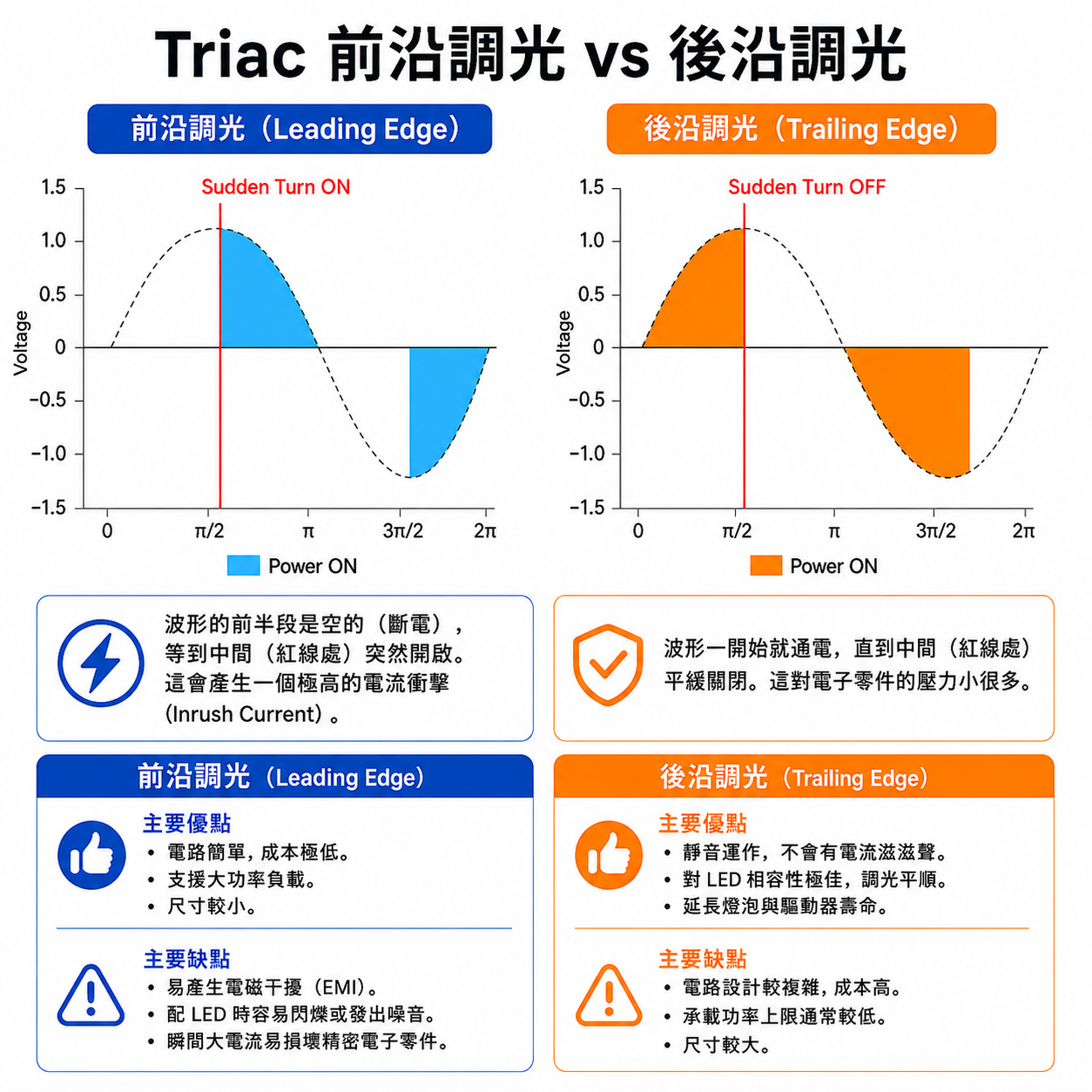
LeadingThe power is cut off at the beginning of each AC waveform and then suddenly switched on partway through the cycle. This can generate very high instantaneous inrush current, making it more suitable for traditional high-wattage incandescent and halogen lamps. It also tends to be more cost-effective.
Trailing**Trailing-edge dimming:** The AC waveform conducts from the beginning of each cycle and is then smoothly switched off partway through. This results in gentler current transitions, reduces stress on electronic components, and provides quieter operation, making it well suited for modern... LED Lighting Systemsmaking it the preferred choice for modern LED lighting systems and precision smart control equipment.
I. In-Depth Analysis of Dimming Technology Principles: Waveforms and Current Characteristics
Understanding the fundamentals of dimming technology begins with examining the actual power output—the conduction interval—within each alternating current (AC) sine-wave cycle.
1. How Leading-Edge Dimming Works
Leading-edge dimming works by cutting off the current at the beginning of each AC waveform cycle and keeping it off until partway through the cycle, when the current is then switched on.Instant Turn-On。
Physical CharacteristicsThis abrupt transition from zero current to full conduction can generate extremely high...Inrush Current。
Impact on Hardware: Impact on Hardware:** The stronger current surge can place a sudden high electrical load on downstream electronic components.
2. How Trailing-Edge Dimming Works
Trailing-edge dimming uses the opposite approach. The current remains on from the beginning of each AC waveform cycle and is only switched off partway through the cycle.Smooth Turn-Off (Sudden Turn-Off with a Gradual Current Decrease)。
Physical Characteristics: This conduction-first, cut-off-later mechanism results in smoother changes in voltage and current.
Impact on Hardware: This significantly reduces sudden voltage surges during turn-on, making it more suitable and less stressful for electronic drivers compared with leading-edge dimming.
II. Comparative Analysis of the Advantages and Disadvantages of Leading-Edge and Trailing-Edge Dimming
For easier engineering planning and equipment selection, the following section provides a comprehensive comparison of the key performance characteristics of both dimming technologies:
| Evaluation Item | Leading | Trailing |
| Operating Principle | Sudden turn-on partway through the AC cycle | Smooth turn-off partway through the AC cycle |
| Cost & Circuit Design | Simple circuit design with relatively low implementation costs | More sophisticated and complex circuitry with higher manufacturing costs |
| Power Handling | Capable of handling higher power loads | Typically has a lower maximum power capacity |
| Physical Size | More compact and easier to integrate into electrical boxes | Typically larger in physical size |
| Electromagnetic Interference (EMI) | Abrupt switching can generate higher levels of high-frequency EMI | More stable operation with significantly lower interference |
| LED Compatibility | Lower compatibility; may cause LED flickering or audible driver noise | Excellent;provides smooth dimming performance and quiet operation |
| Impact on Equipment Lifespan | High instantaneous current can place greater stress on sensitive electronic components | Gentler waveforms can help extend the service life of LED fixtures and drivers |
III. Engineering Applications: How to Choose the Right Dimming Technology for Your Lighting System?
When selecting a dimming system, the end load (type of lighting fixture) and application environment should be the primary factors in determining the most suitable dimming technology.
1. When to Choose Trailing-Edge Dimming — The Preferred Choice for Modern LED Lighting
With the widespread adoption of LED lighting technology, trailing-edge dimming has become a mainstream solution for commercial spaces and high-end residential applications.
All-LED Lighting Systems: Helps ensure flicker-free, quiet, and smooth lighting performance.
Smart Lighting and Precision Control: Offers excellent compatibility with modern digital lighting control systems.
Long-Term Operation Projects: Helps protect lighting fixtures and drivers, reducing long-term maintenance and replacement costs.
2. When to Choose Leading-Edge Dimming
傳統照明保留區:大量使用傳統白熾燈或鹵素燈的場域。
高功率負載需求:單一迴路需要承載極高瓦數的特殊照明設計。
Budget-Sensitive Basic Projects: A cost-effective solution when LED compatibility is not a primary consideration.
IV. Frequently Asked Questions (FAQ)
Q1: Why are modern LED fixtures generally not recommended for use with leading-edge dimmers?
Leading-edge dimming can generate high inrush current when the waveform suddenly begins conducting. Because LED drivers contain sensitive electronic components, these abrupt electrical stresses may cause LED flickering, audible or high-frequency electrical noise, and increased stress on the driver circuitry. In severe cases, incompatible combinations may contribute to premature driver failure.
Q2: Is trailing-edge dimming always better than leading-edge dimming?
For most modern LED applications, trailing-edge dimming generally provides better performance. However, if a project primarily uses high-power traditional lighting, or if there are strict limitations on cost or installation space, leading-edge dimming may still offer practical advantages.
Q3: How can I determine which phase-cut dimming technology a fixture supports before installation?
The safest approach is to check the product label and technical specifications of the LED fixture or driver. Most modern dimmable LED drivers clearly indicate whether they support leading-edge, trailing-edge, or both types of phase-cut dimming. If this information is not clearly specified, consult the equipment supplier before installation to ensure system compatibility and avoid flickering or other abnormal dimming behavior after installation.